
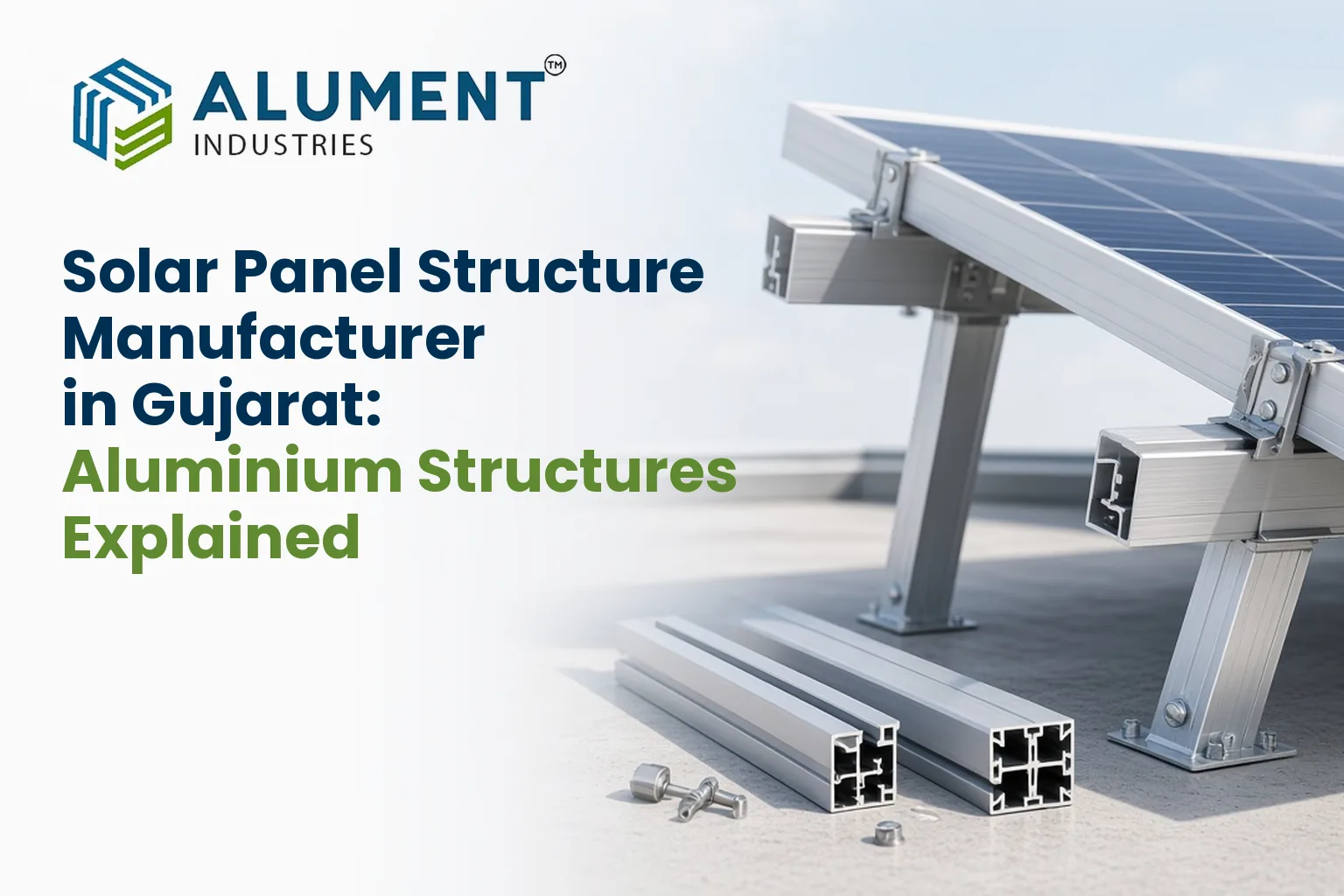
A solar panel gets all the attention, but it doesn’t hold itself up. For twenty-odd years, rain, wind and sun will test whatever sits underneath it.
If you’re searching for a reliable solar panel structure manufacturer in Gujarat, it pays to understand why aluminium is often the metal of choice, what to write into your specification and how to judge a maker before you order.
Why Aluminium Gets Chosen
Aluminium is light, which makes sections easier to carry, lift and fit, especially on rooftops. It resists corrosion better than plain steel. And it can be extruded into shapes with grooves, channels and slots designed for the job, so one section can do work that would otherwise need several parts.
Those traits explain why aluminium shows up so often in mounting rails and supports. They don’t make it right for every project.
Aluminium vs. Steel: A Structural Engineering Comparison
Steel remains a widely specified alternative for solar mounting systems, offering distinct mechanical characteristics. Evaluating the two materials requires balancing structural demands, environmental factors, and site logistics:
Weight and Handling
Aluminium provides a high strength-to-weight ratio, weighing roughly one-third as much as steel. This lightweight profile reduces structural dead load on rooftops, simplifies site logistics, and enables safer, faster manual assembly without heavy lifting equipment.
Corrosion Resistance
Aluminium naturally forms a protective oxide layer that resists atmospheric corrosion, weathering, and moisture without requiring ongoing maintenance. In contrast, steel requires protective galvanization or specialized coatings to prevent rust, particularly in humid or coastal environments.
Structural Stiffness
Steel offers higher structural rigidity and tensile strength for equivalent section dimensions. Consequently, large-scale ground-mounted arrays, high-wind installations, or long-span structures frequently lean toward steel to withstand severe structural loads.
Fabrication and Shape Freedom
The extrusion process allows aluminium to be manufactured into complex, custom cross-sectional profiles with integrated mounting channels. This design flexibility streamlines structural connections and speeds up on-site racking assembly compared to standard fabricated steel shapes.
Ultimately, material selection depends on site-specific wind loads, soil conditions, and structural calculations. Final specifications should always be determined by a qualified structural engineer rather than general marketing material.
What the Structure Has to Survive
Mounting structures live outdoors for years. They face wind pressing and lifting on the panels, heat and cold cycles, rain, dust and, in some places, salty or humid air. Loads depend on the site and the layout, and your engineer sets them. As a buyer, your job is to pass those requirements on clearly and to ask the manufacturer to confirm they can meet them.
What to Specify
Put these in writing:
- Section profiles: drawings or names, including wall thickness and tolerance.
- Alloy and temper: state them if your design needs them, and ask for written confirmation.
- Lengths: standard or cut to size.
- Holes and slots: positions and sizes for fixing, if drilling is required.
- Finish: as extruded, anodised or powder coated, with a sample on your section.
- Quantity and schedule: one-off or repeating, with delivery dates.
If you want to see how sections are made in the first place, how an aluminium extrusion plant in Gujarat works is a helpful background.
Surface Finishing and Long-Term Corrosion Protection
On outdoor mounting structures, a finish isn’t only cosmetic, it is the primary defense against atmospheric corrosion and oxidation over time. When evaluating suppliers, ask what finishing options (such as anodizing or protective coating) are available, whether they’re performed in-house or through a partner, and how coating thickness and quality are tested to guarantee corrosion resistance.
Additionally, ask how finished sections are protected during packing; surface scratches during transit expose bare metal, creating immediate corrosion initiation points and causing an avoidable cost before installation even begins.
Fit With the Rest of the System
A structure doesn’t stand alone. It has to work with the panel frames, clamps, fasteners and any other rails in your system. Check that the grooves, slots and hole sizes suit the hardware you plan to use. Mixing sections from different sources can leave parts that almost fit, which is worse than parts that clearly don’t.
Choosing the Trusted Manufacturer
Look for a maker who answers technical questions directly and explains their process in plain words. Ask these things:
- Who makes and maintains the dies?
- How are dimensions, straightness and finish checked before dispatch?
- What documents come with a delivery?
- Can they handle a trial quantity as well as repeat runs?
- How will you be told if a date slips?
Don’t assume certifications. If one matters to your project, ask for the document and confirm it’s current.
Sourcing Solar Mounting Structures: Regional Manufacturing Advantages
Searching for a solar panel structure manufacturer in India gives a wide field. Narrowing to Gujarat, or to a city such as Rajkot with a solar panel structure manufacturer in Rajkot, brings suppliers closer, which makes visits and sample checks easier. Location is a convenience, not a quality guarantee, and the questions above apply wherever the supplier sits.
Aluminium also appears further along the solar supply chain, which is why the article on the solar panel manufacturer in Gujarat covers where it fits in the bigger picture.
Join Hands With Alument Industries
Alument Industries is an aluminium extrusion business in Gujarat. To discuss a solar structure requirement, send your drawings, finish and quantity to our team at Alument Industries.
Frequently Asked Questions
Why is aluminium used for solar mounting structures?
It’s light, resists corrosion and can be extruded into custom shapes, which makes installation and design easier.
What should I give a manufacturer to get a correct quote?
Drawings or profiles, alloy and finish requirements, lengths, hole details, quantity and delivery schedule.
Is aluminium better than steel for solar structures?
Neither is better in every case. The choice depends on the design, loads and site, and should be confirmed by your engineer.