
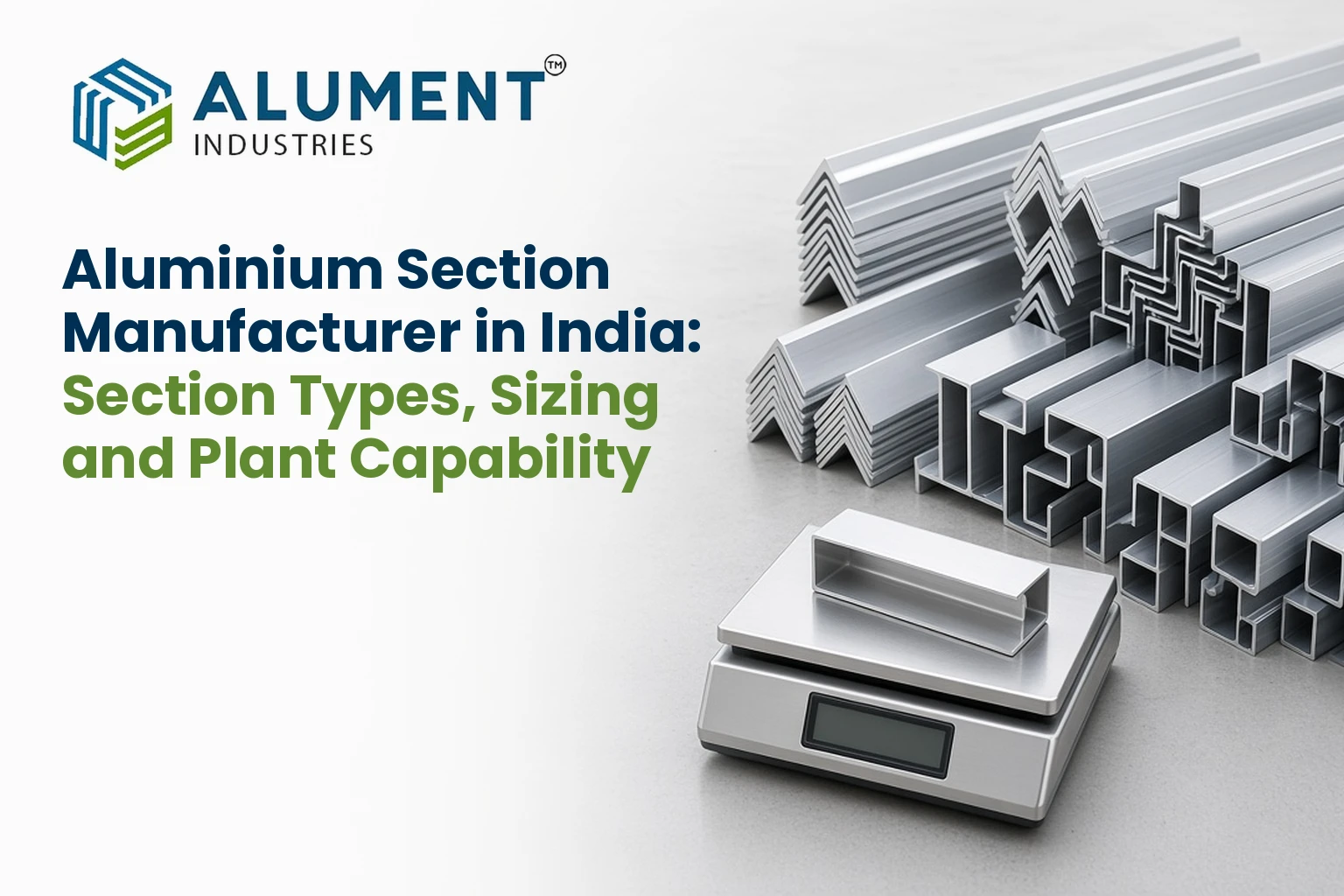
Aluminium sections are the building blocks of countless frames, supports and structures. An angle forms a corner trim, a channel holds glass, a box section carries a load, a T-section ties two panels together. Because sections are often load-bearing, buyers need more than a shape: they need the right alloy, the right size and confidence that every length meets its tolerances.
This guide explains the main section types, how to size and weigh them, and what an aluminium section plant needs to produce them consistently. For our product range, visit our page as an aluminium section manufacturer in India.
Common Aluminium Section Types
| Section | Shape | Typical uses |
|---|---|---|
| Angle | L-shape, equal or unequal legs | Corner protection, frames, brackets |
| Channel | U, C, H, F, L or T shapes | Glass retention, tracks, panel framing |
| T-section | T-shape | Joining panels, partitions, supports |
| Box section | Hollow square or rectangle | Frames, structures, furniture |
| U-profile | U-shape | Edge trims, sliding tracks |
| Flat bar | Solid rectangle | Strips, fixings, bus bars |
| Pipe and tube | Round, square or rectangular hollow | Handrails, frames, structures |
| Window and door sections | System-specific | Sliding and casement windows, doors |
Purpose-designed shapes for specific products are usually called profiles. See our guide to aluminium profile manufacturers in India.
Choosing Alloy and Temper for Sections
| Alloy | Strength | Best for |
|---|---|---|
| 6063-T5 / T6 | Moderate | Window and door sections, trims, light frames; best surface finish |
| 6061-T6 | High | Structural frames, brackets, machined parts; good weldability |
| 6082-T6 | Highest in the 6xxx series | Heavy-duty structures and load-bearing members |
Read 6063 vs 6061 aluminium alloy, or browse alloy-specific products such as 6061 angles and 6063 angles.
How to Size an Aluminium Section
- Load and span: the longer the span and heavier the load, the stiffer the section needs to be. Deeper sections resist bending far better than wider, shallow ones.
- Wall thickness: thicker walls add strength and resist denting, but also add weight and cost.
- Hollow vs open: box sections resist twisting much better than open channels or angles of similar weight.
- Connections: allow space for screws, bolts or welding.
- Engineering check: for structural uses, have a qualified engineer confirm the section size and alloy.
Calculating Weight Per Metre
Aluminium has a density of about 2.7 g/cm³. To estimate weight:
Weight (kg/m) ≈ cross-sectional area (mm²) × 0.0027
Example: an equal angle of 40 × 40 mm with 3 mm thickness has an area of roughly (40 + 40 − 3) × 3 = 231 mm². Its weight is about 231 × 0.0027 ≈ 0.62 kg per metre. Weight matters because sections are usually priced per kilogram, so a thinner wall that still meets the design load can reduce cost.
Tolerances and Standards
In India, IS 733 covers wrought aluminium bars, rods and sections, and many manufacturers also work to EN 755. Alument Industries maintains wall thickness tolerances of about ±0.15 mm and profile dimension tolerances of about ±0.20 mm, along with straightness and twist control. See our technical capabilities.
What a Section Plant Needs
- Press capacity: determines the largest section size and heaviest wall the plant can extrude.
- Die library: standard sections from existing dies save tooling cost and time.
- Stretching and ageing: stretchers straighten sections, and ageing ovens deliver the specified temper.
- Finishing lines: anodizing and powder coating protect and colour the sections. See our anodised aluminium sections.
- Fabrication: CNC cutting, drilling and punching deliver ready-to-fit sections.
- Quality control: measurement, hardness checks and documentation for every batch.
Our process page shows how these steps fit together, and the aluminium extrusion process guide explains the science.
Alument Industries: Aluminium Section Plant in India
Alument Industries operates an ISO 9001:2015 certified aluminium section plant in Morbi district, Gujarat, with:
- An 800 MT hydraulic press with PLC control and billets up to 7 inches
- 4,000 MT annual extrusion capacity
- 500+ standard dies, plus custom extrusion in 7 to 10 working days
- Alloys 6063, 6061 and 6082 in T5 and T6 tempers
- In-house anodizing, powder coating and CNC fabrication
We supply sections to the construction, solar, automotive, engineering and defence industries across India and abroad. Popular items include aluminium extrusion sections, square extrusions and channel sections.
Related Reading
- Aluminium profile manufacturer in India
- Aluminium profile manufacturer in Gujarat
- Inside our aluminium extrusion plant in Morbi
Frequently Asked Questions
What is an aluminium section?
An aluminium section is an extruded length with a standard structural cross-section, such as an angle, channel, T-section, box section, flat bar or tube. Sections are used for frames, supports, trims and structures across construction and industry.
How do I calculate the weight of an aluminium section?
Multiply the cross-sectional area in square millimetres by 0.0027 to get the approximate weight in kilograms per metre, based on aluminium's density of about 2.7 g/cm³. For example, a section with 400 mm² of area weighs about 1.08 kg per metre.
Which alloy should I use for structural aluminium sections?
6061-T6 and 6082-T6 are commonly chosen for load-bearing sections because of their higher strength. 6063-T5 or T6 suits lighter frames, trims and sections where surface finish matters more than strength.
Which standard applies to aluminium sections in India?
IS 733 covers wrought aluminium and aluminium alloy bars, rods and sections in India. Many manufacturers, including Alument Industries, also work to EN 755 for tolerances and properties.
What lengths are aluminium sections supplied in?
Alument Industries supplies sections in standard lengths of up to 6 metres, with custom lengths and cut-to-size pieces available on request.
Get Section Prices
Share the section type, size, alloy, finish and quantity. Request a quote or call +91 99138 22221.