
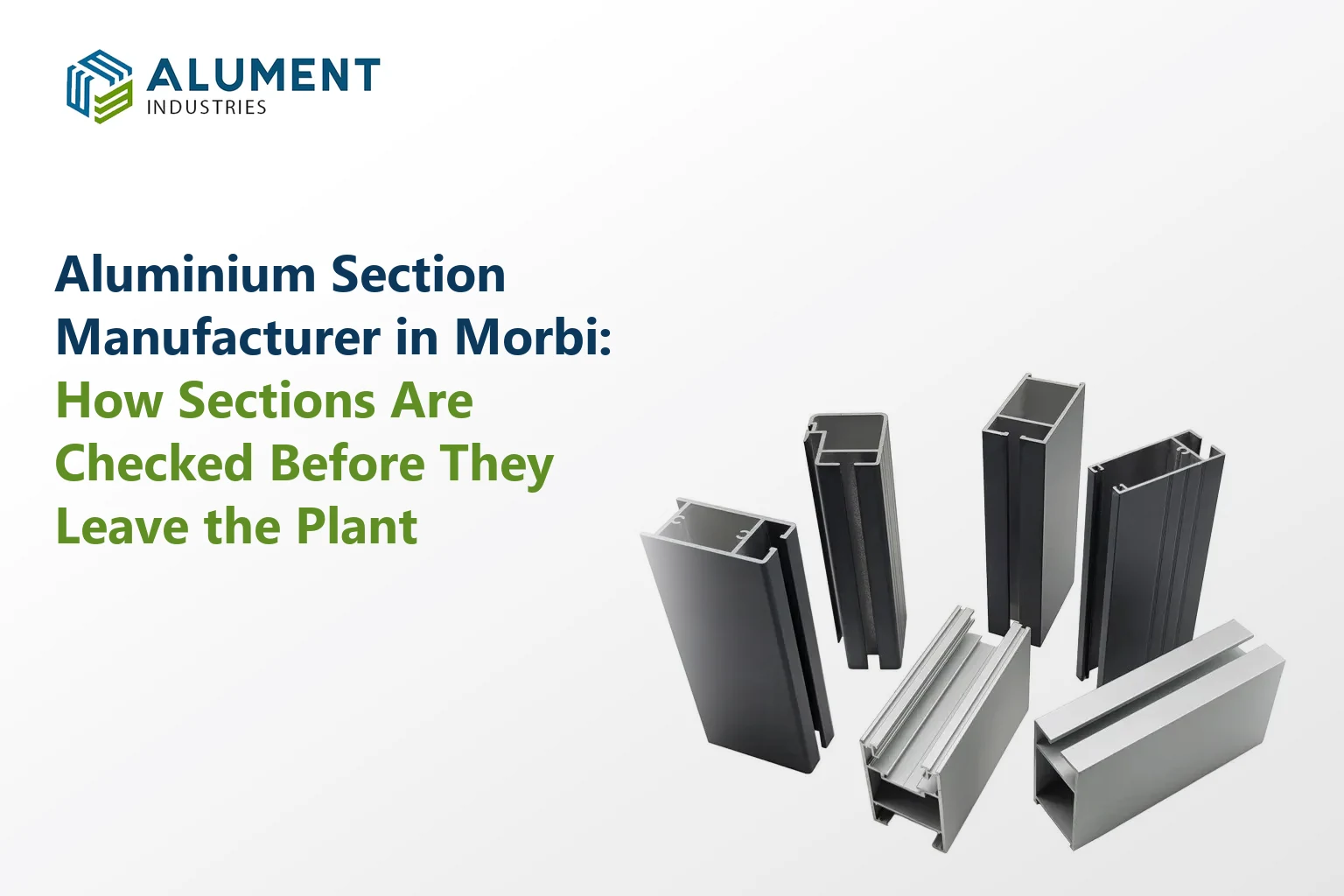
Most buyers never see what happens between the extrusion press and the delivery truck. Yet that is where a section either becomes reliable or turns into a problem on your shop floor: a twisted length that will not fit, a wall that is too thin, a coating that scratches off. This article walks through the checks an aluminium section manufacturer in Morbi should run, and what you can look for when you visit or receive a delivery.
For an overview of the plant itself and the extrusion process, read inside Alument's aluminium extrusion plant in Morbi.
Where Checks Happen
| Stage | What is checked |
|---|---|
| Billets | Alloy grade and condition before extrusion |
| Die setup | First pieces measured against the drawing before the run continues |
| During extrusion | Periodic dimension and surface checks |
| After stretching and ageing | Straightness, twist and hardness |
| After finishing | Coating or anodic film thickness, colour and adhesion |
| Before dispatch | Length, count, labelling and packing |
1. Dimensions and Wall Thickness
External dimensions, internal features and wall thickness are measured against the drawing using calipers, micrometers and gauges. Wall thickness matters most for strength and for fitting accessories. Standard tolerance ranges, such as those in EN 755 and IS 733, guide acceptance unless tighter limits are agreed. Alument extrudes walls from about 0.8 mm, depending on the section design.
2. Straightness and Twist
After extrusion, sections are stretched to straighten them. Long lengths are then checked for bow and twist on a flat surface. A twisted section may look fine alone but cause problems when assembled into frames or fitted to other parts.
3. Hardness and Temper
Ageing gives sections their final temper, such as T5 or T6. Hardness checks confirm the ageing worked as intended. Under-aged sections can be too soft for machining or load-bearing use.
4. Surface Quality
Inspectors look for die lines, scratches, pick-up, blisters and other defects. Visible faces for architectural or decorative use need stricter surface standards than hidden structural parts, so agree which faces matter.
5. Finish Checks
- Anodised sections: film thickness and colour consistency. See anodised aluminium sections.
- Powder coated sections: coating thickness, colour match and adhesion.
Read powder coating vs anodizing to choose between them.
6. Length, Count and Packing
Lengths are checked against the order, bundles are counted and labelled, and finished sections are protected with interleaving or film so they do not rub against each other during transport.
What You Can Check on a Plant Visit
- Ask to see first-piece measurement records for your section.
- Watch straightness and twist checks on a few lengths.
- Look at how finished sections are stored and packed.
- Ask which test reports come with a delivery.
Visiting Morbi is easy from Rajkot and the rest of Saurashtra; call ahead to plan a visit with the quality team.
What to Check When a Delivery Arrives
- Count bundles and lengths against the delivery note.
- Measure a few sections at critical dimensions.
- Lay a length on a flat surface to check bow and twist.
- Inspect visible faces and finish under good light.
- Report any issues promptly with photos.
Dispatch From Morbi
From Morbi, sections reach Rajkot, Ahmedabad and the rest of Gujarat by road, and export orders move through nearby ports such as Kandla and Mundra. Alument exports to the Middle East, Africa, Europe and Asia.
Sections Made in Morbi
Alument produces extrusion sections, box sections, T-sections, window sections, door sections and custom sections for buyers across India and abroad.
About Alument Industries
Alument Industries is an ISO 9001:2015 certified aluminium extrusion manufacturer with its plant at Survey No. 71P, Dhamalpar, Wankaner, Dist. Morbi, Gujarat, and an office in Rajkot. The plant runs an 800 MT PLC-controlled press with around 4,000 MT of annual capacity and 500+ dies, producing profiles, sections, angles, channels, pipes and solar structures in 6063, 6061 and 6082 alloys to IS 733 and EN 755. See our technical capabilities and process.
Related Reading
- Inside Alument's aluminium extrusion plant in Morbi
- Aluminium section manufacturer in Gujarat: buying direct vs through traders
Frequently Asked Questions
What quality checks are done on aluminium sections?
Billet checks, first-piece measurement, dimension and wall thickness checks, straightness and twist, hardness, surface inspection, finish thickness and adhesion, and length, count and packing checks.
What standards apply to aluminium section tolerances?
Standards such as EN 755 and IS 733 set common tolerance ranges unless tighter limits are agreed between buyer and manufacturer.
Why does straightness matter in aluminium sections?
Bowed or twisted sections cause fitting and assembly problems in frames and fabricated parts, even when individual dimensions are correct.
Can I visit Alument's plant in Morbi?
Yes. Buyers can arrange a visit with the quality team to see measurement records, straightness checks, storage and packing.
What should I check when aluminium sections are delivered?
Count bundles, measure critical dimensions on a few pieces, check bow and twist on a flat surface, inspect finish and report issues with photos.
Plan a Visit or Request Section Samples
Request a quote, call +91 99138 22221, message us on WhatsApp or email info@alumentindustries.com with your drawing, alloy, finish and quantity.