
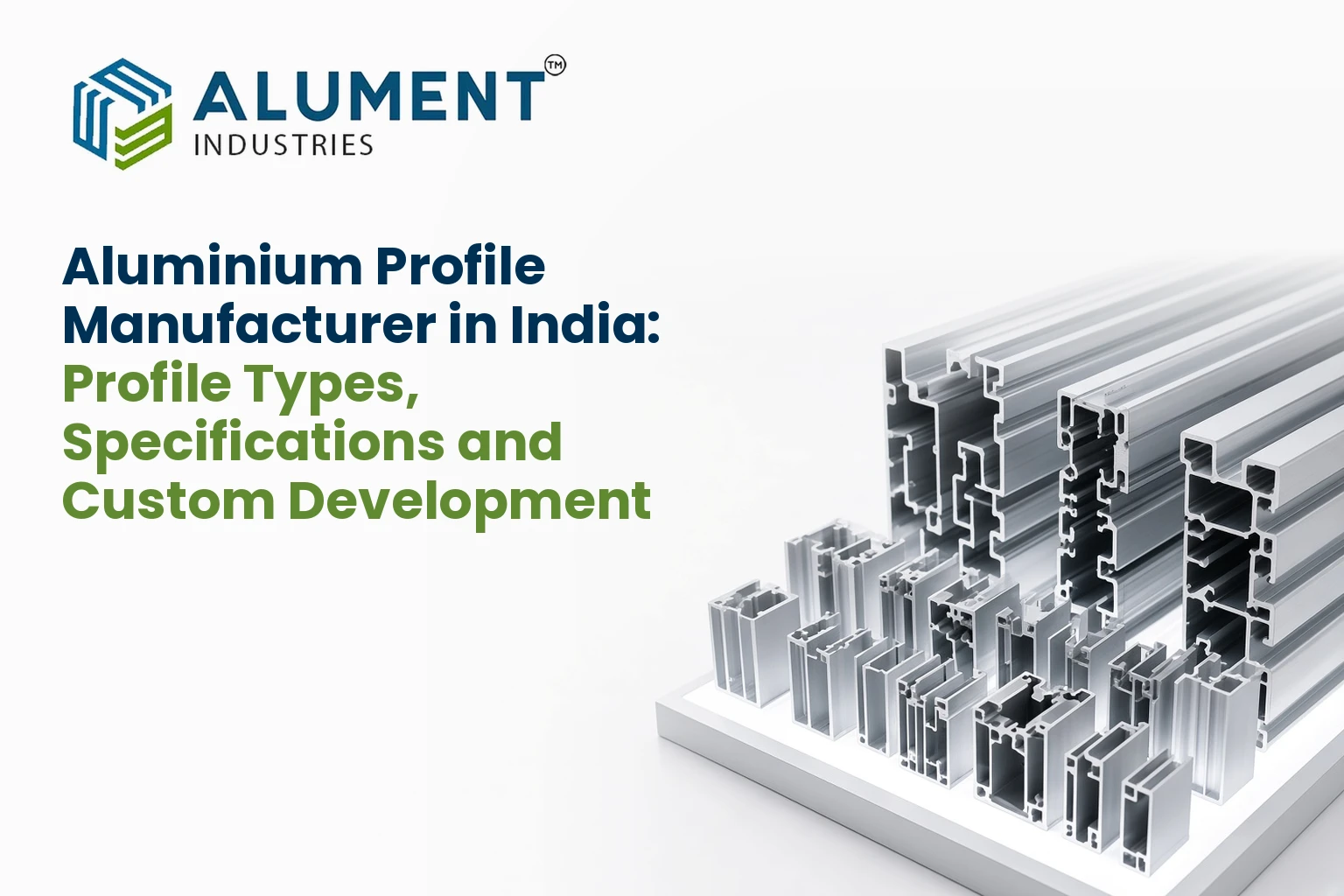
Aluminium profiles are everywhere once you start looking: in sliding windows, kitchen shutters, LED strip lights, glass partitions, machine guards and solar mounting systems. Each one is a carefully designed cross-section, extruded to tight tolerances and finished to suit its environment. Getting that profile right depends heavily on the manufacturer you choose.
This guide focuses on the profile itself: the main types, the specifications that define it, and how a new custom profile goes from drawing to delivery. If you need a supplier now, explore our range as an aluminium profile manufacturer in India. To evaluate extrusion plants more broadly, read our guide to choosing an aluminium extrusion plant in India.
Profiles, Sections and Extrusions: What's the Difference?
All three terms describe extruded aluminium, and buyers often use them interchangeably. In practice, profile usually means a purpose-designed shape for a specific product, such as a window frame or an LED housing. Section often refers to more standard structural shapes such as angles, channels, T-sections and box sections. Both are extrusions. For standard structural shapes, see our guide to aluminium section manufacturers in India.
Main Types of Aluminium Profiles
| Profile family | Typical use | Examples |
|---|---|---|
| Architectural | Doors, windows, partitions, façades | Window profiles, door profiles, glass partition profiles |
| Interior and furniture | Modular kitchens, wardrobes, wall finishes | Kitchen profiles, Gola profiles, shutter profiles, skirting profiles |
| Lighting | LED strips, linear lights, heat sinks | LED profiles |
| Industrial | Machine frames, guards, workstations, conveyors | Industrial profiles, heavy profile extrusions |
| Solar | Panel frames and mounting rails | Solar rail profiles, panel frames |
| Electrical and motors | Enclosures and housings | Motor body extrusions, inverter enclosures |
Our article on the top 10 applications of aluminium profiles in construction covers building uses in more detail.
The Five Specifications That Define a Profile
1. Cross-section geometry
The drawing defines every dimension: outer size, wall thicknesses, slots, screw ports and hollows. Uniform wall thickness extrudes more easily and more consistently than shapes with very thick and very thin walls side by side.
2. Alloy and temper
6063 is the standard for most profiles because it flows well through complex dies and gives the best surface finish. 6061 and 6082 offer more strength for load-bearing industrial parts. Tempers such as T5 and T6 set the final strength. See 6063 vs 6061 aluminium alloy.
3. Tolerances
Dimensional, straightness and twist tolerances decide whether parts fit together on site. Ask which standard the manufacturer follows; Alument works to IS:733 and EN 755. Details are on our technical capabilities page.
4. Length and fabrication
Standard lengths run up to 6 metres, with custom lengths available. Cutting, drilling, punching and tapping at the plant deliver ready-to-assemble parts.
5. Surface finish
Mill finish, anodised profiles, powder coating, wood grain and brushed finishes each suit different uses. Our guide to powder coating vs anodizing explains the trade-offs.
How a Custom Aluminium Profile Is Developed
- Brief and drawing: share a drawing, sketch or sample with the application and quantity.
- Design review: engineers check extrudability and may suggest small changes, such as evening out wall thickness, that improve quality and cost.
- Die design and manufacture: a steel die is made for the approved shape, typically within 7 to 10 working days at Alument.
- Trial extrusion: sample lengths are extruded and measured.
- Sample approval: you check fit and function before bulk production.
- Production and finishing: profiles are extruded, aged, finished, fabricated and packed.
With more than 500 standard dies in our library, many shapes are available without new tooling. Learn more about custom aluminium extrusion and our manufacturing process.
Design Tips That Save Cost
- Keep wall thickness as uniform as the design allows.
- Add generous radii instead of sharp internal corners.
- Avoid very deep, narrow channels that stress the die.
- Check whether an existing die can do the job before ordering a new one.
- Combine features into one profile to reduce assembly steps.
Alument Industries: Aluminium Profile Manufacturer
Alument Industries manufactures aluminium profiles at its ISO 9001:2015 certified plant in Morbi district, Gujarat, on an 800 MT PLC-controlled press with 4,000 MT annual capacity. We supply construction, interiors, lighting, solar, automotive and engineering customers across India and export to the Middle East, Africa, Europe and Asia. See the industries we serve and our certifications.
Related Reading
- Aluminium profile manufacturer in Gujarat: profiles for local industries
- Aluminium section manufacturer in India: types and sizing
- How to evaluate an aluminium extrusion company in India
Frequently Asked Questions
What is an aluminium profile?
An aluminium profile is a length of aluminium with a specific cross-section, made by pushing a heated billet through a shaped die. Profiles can be simple shapes or complex designs with slots, grooves, hollows and snap-fit features for doors, windows, furniture, lighting and machines.
Which alloy is used for most aluminium profiles?
6063 is the most widely used alloy for profiles because it extrudes well into complex shapes and gives an excellent surface for anodizing and powder coating. 6061 and 6082 are chosen when higher strength is needed.
How long does it take to develop a custom aluminium profile?
At Alument Industries, custom die development typically takes 7 to 10 working days after the profile drawing is approved, followed by trial extrusion and sample approval.
What information should I send for an aluminium profile quote?
Send a dimensioned drawing or sample, the application, alloy and temper if known, length, finish and colour, quantity, and any fabrication such as cutting, drilling or punching.
What is the minimum wall thickness for an aluminium profile?
It depends on the profile size, shape and press. Alument Industries produces profiles with wall thicknesses down to 0.8 mm on its 800 MT press.
Send Us Your Profile Drawing
Request a quote and get a response within 24 hours, or call +91 99138 22221. Browse our catalogues for standard profiles.